
| ||
| The Ovation Fan Club | ||
| ||
| Random quote: "One good thing about music, when it hits you, you feel no pain." - Bob Marley |
 Refinishing an OLD Top Refinishing an OLD Top
| View previous thread :: View next thread | |
| Members Forums -> General Posting | Message format | |
Jimbob |
| ||
Joined: December 2009 Posts: 143 Location: Ontario Canada | Thanks to everyone for the responses, I think I'll keep playing my 1615 (1979 vintage)with the crack and avoid any possible hassles with the cross border paperwork from Canada. Although I have no experience myself on this issue, I am just going with the reports I have heard from friends who have dealt with other manufacturers. Jim. | ||
| |||
| twistedlim |
| ||
Joined: November 2008 Posts: 1119 Location: Michigan | Photoshop does a great job taking care of surface cracks. | ||
| |||
| Mr. Ovation |
| ||
Joined: December 2001 Posts: 7248 Location: The Great Pacific Northwest | "aren't we assuming what the effects would be if that top was refinished." Exactly... why mess with it? There "could" be minimal difference, but more likely as the finish is adhered to the top, the top thickness changes, the finish thickness changes, the type (chemical makeup of the finish) is different... I just would not risk it unless there was something physical wrong with the guitar. As you mention.. the wood opened up... to the point where the vibration and other factors caused the finish to crack. The finish isn't particularly plyable.. although it is somewhat... so a new finish will restrict the top. And don't get me wrong... my Pacemaker sounds great... as long as the other one isn't in the room.. | ||
| |||
| Jimbob |
| ||
Joined: December 2009 Posts: 143 Location: Ontario Canada | Originally posted by Mr. Ovation: Thank you Miles for setting my mind at ease. Mine sounds great and there isn't another one around so it is the champion of all the twelve string tone contraptions. :) "aren't we assuming what the effects would be if that top was refinished." Exactly... why mess with it? There "could" be minimal difference, but more likely as the finish is adhered to the top, the top thickness changes, the finish thickness changes, the type (chemical makeup of the finish) is different... I just would not risk it unless there was something physical wrong with the guitar. As you mention.. the wood opened up... to the point where the vibration and other factors caused the finish to crack. The finish isn't particularly plyable.. although it is somewhat... so a new finish will restrict the top. And don't get me wrong... my Pacemaker sounds great... as long as the other one isn't in the room.. Jim. | ||
| |||
| bburg |
| ||
Joined: August 2009 Posts: 1137 Location: Germany, where delicious wine is growing (Rheinh) | Hi, a very interesting thread! I own two 1615-4. One made in 1978 without any cracks in the top, only some little scratches, in very good shape. The second one made in 1981, bought with a broken headstock and a heavy crack in it's top, from the bridge to the end in the middle of the top, very cheap. I've repaired it's headstock and strung it with the same strings whitch are on the other one. It sounds so great and clear, much better as the other one in good shape. So I never get the idea to repair the top crack. But I can't say something about the sound of the guitars before they are mine. Bernie | ||
| |||
| dobro |
| ||
Joined: January 2006 Posts: 2120 Location: Chicago | I'm persuaded by what Beal and Miles (and others) have to say: the top of my 1117 is OK cosmetically, the cracks have NOT "gone through" the wood etc. Judging from my last session, the axe sounds GREAT. It ain't broke, I won't fix it! | ||
| |||
| moody, p.i. |
| ||
Joined: March 2002 Posts: 15686 Location: SoCal | Looks like I'm in a minority here. Interesting since every guitar I had worked on came back not only looking better but sounding better as well.... | ||
| |||
| noah |
| ||
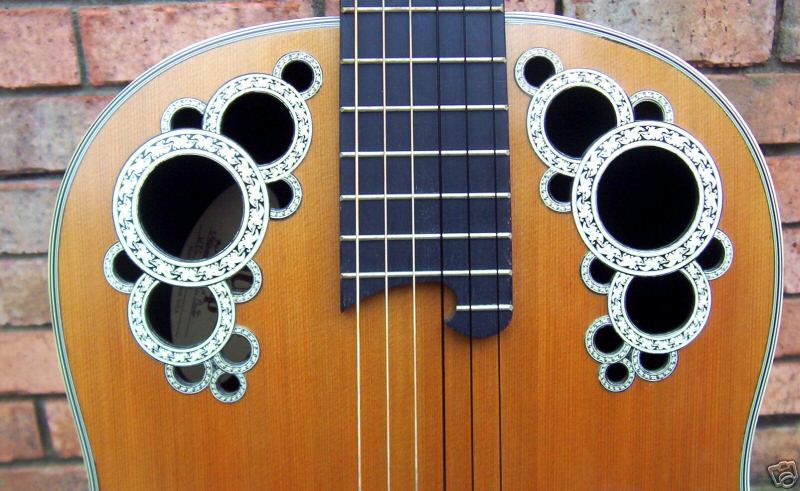 Joined: December 2004 Posts: 1673 Location: SoCal |  | ||
| |||


| Jump to page : 1 2 Now viewing page 2 [25 messages per page] |
| Search this forum Printer friendly version E-mail a link to this thread |
| This message board and website is not sponsored or affiliated with Ovation® Guitars in any way. | |
| (Delete all cookies set by this site) | |